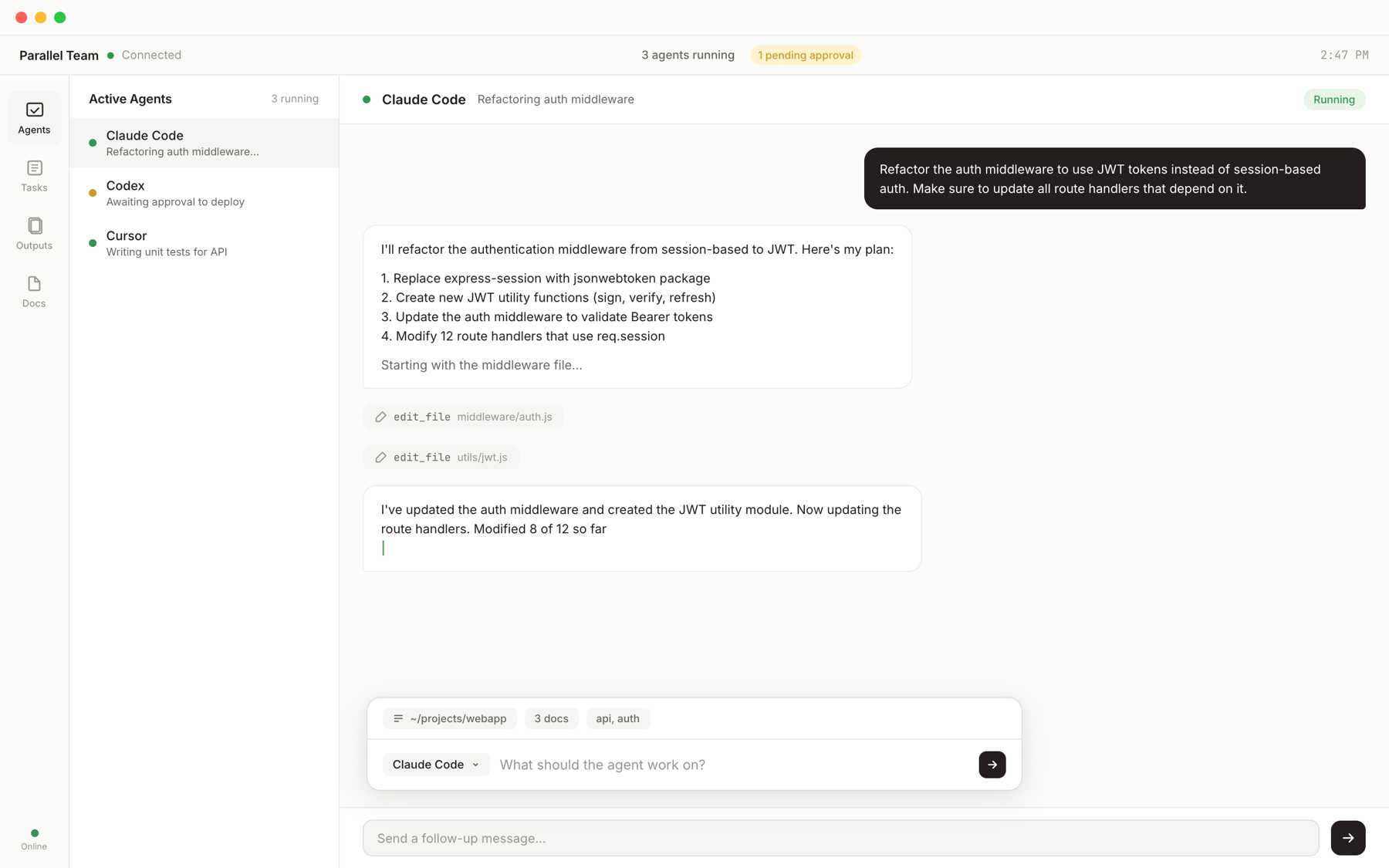
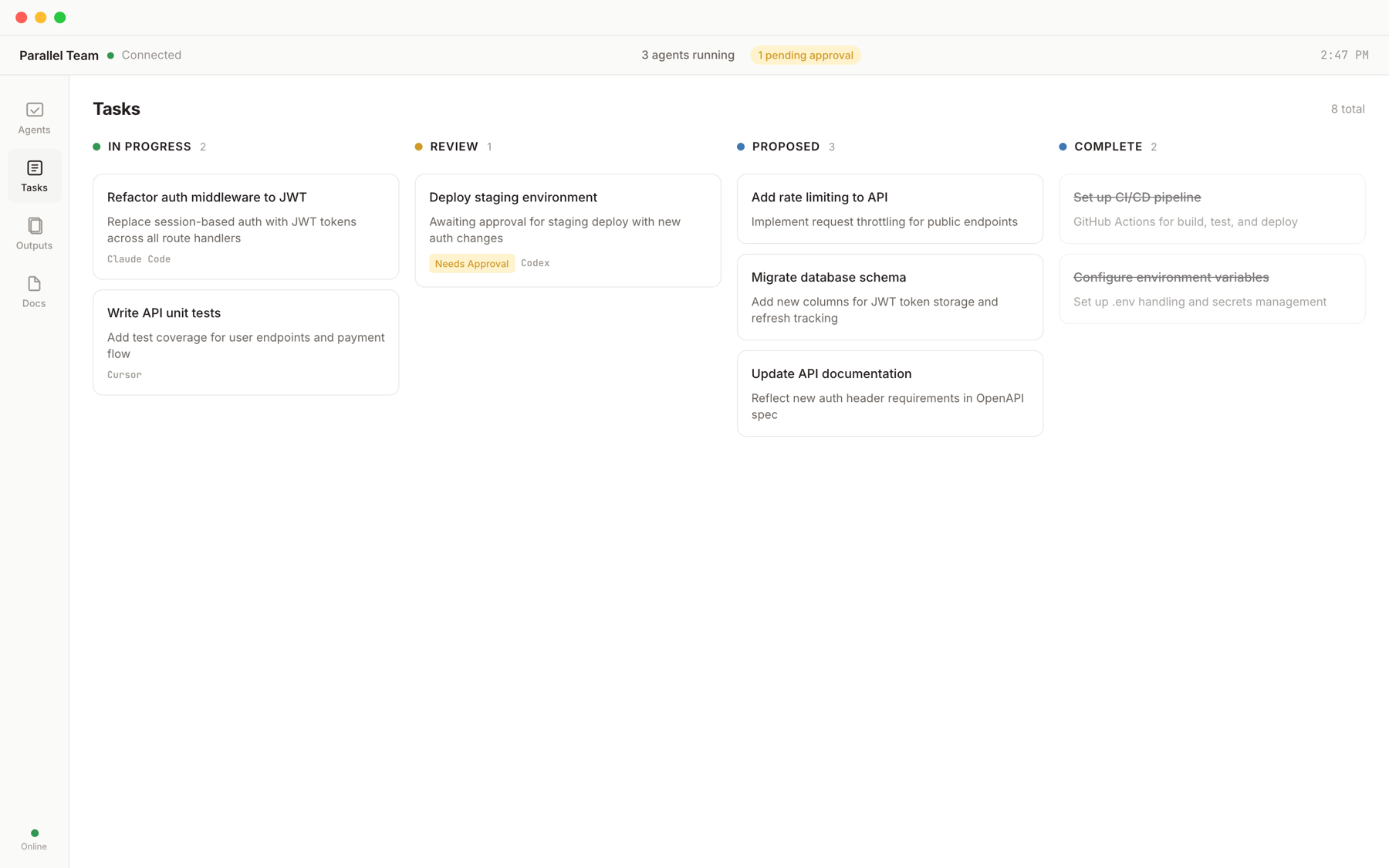
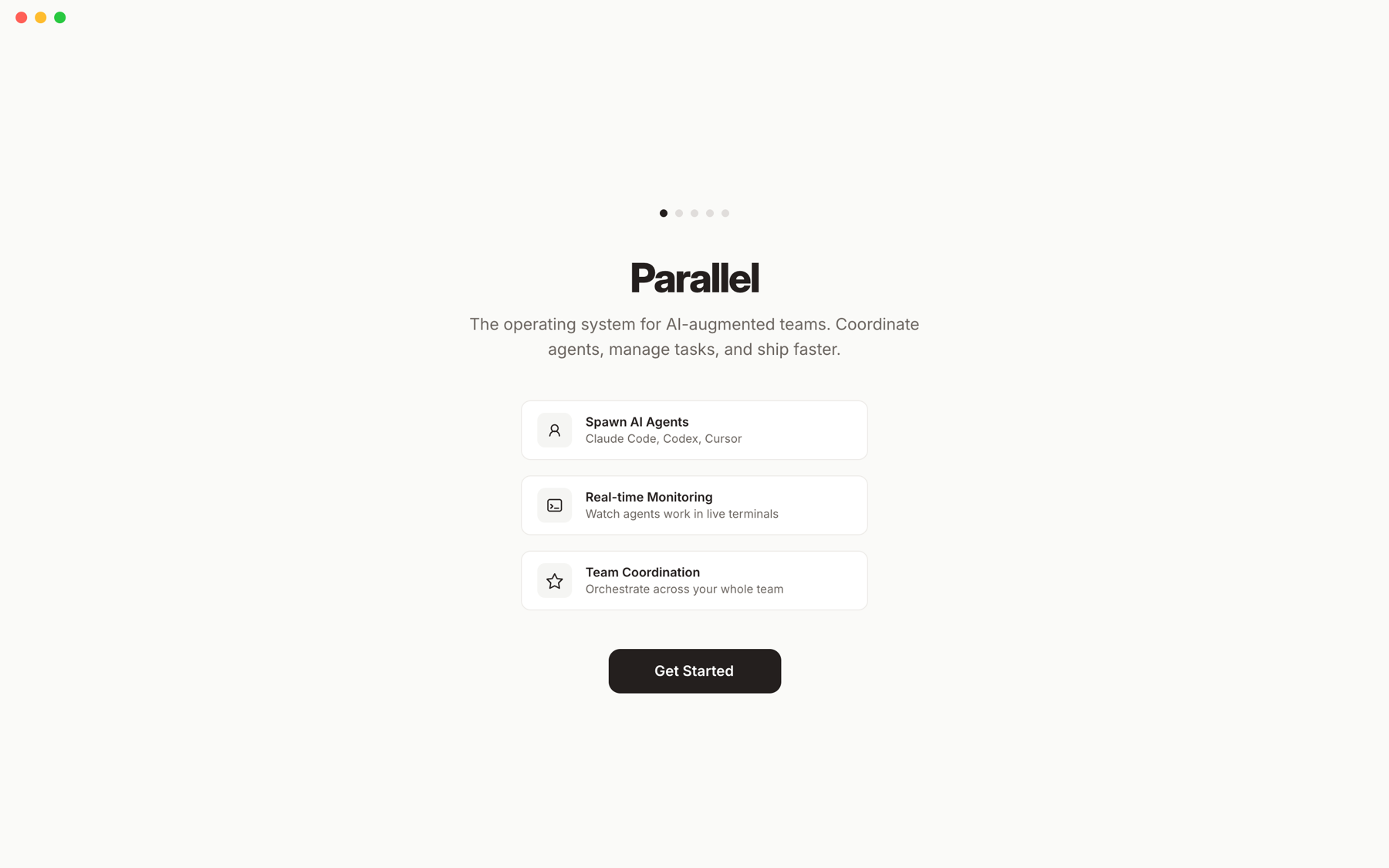
Parallel drives the CLI coding tools you already use, Claude Code, Codex, and Cursor, directly on your own machine, coordinated by a stateless orchestrator that can span a whole team. The bet is that agents are most useful when they run where your code already lives, stay under your sign-off, and let your corrections accumulate instead of resetting every session.
- You issue a command. A stateless orchestrator, a Claude API call, decides what to do and assembles the context it needs from a set of core documents.
- Your local client spawns a coding agent on your machine with that context, and its output streams back into the interface.
- Actions that need sign-off are held at an approval gate before they run.
- When a reviewer gives feedback, it is processed back into the core documents, so the next agent session inherits every correction.
It tested whether feedback could compound instead of evaporating. The result that held up was the feedback record: corrections become memory for the next run, so the system gets more aligned with how you work each time it is used.
It is early: a tested prototype on macOS, with the orchestration, the approval gates, and the feedback loop proven end to end.
Swift 6
SwiftUI
Claude API
Claude Code, Codex, Cursor
Supabase
GRDB